
Marketing Analytics & Reporting: From Data to Decisions
A practical guide to marketing analytics: the metrics that matter, attribution basics, a single source of truth, and automated reporting built with n8n.
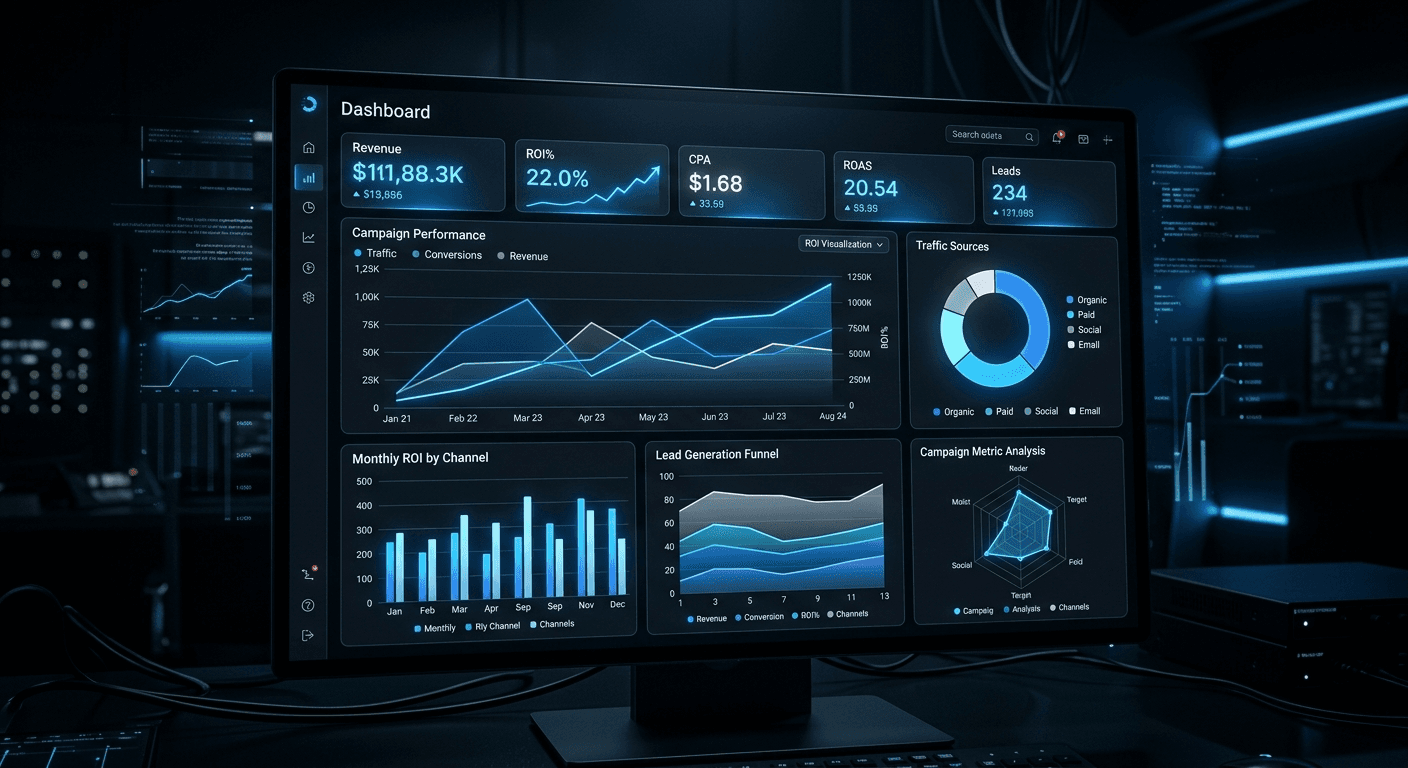
Most marketing teams are not short on data. They are short on clarity. Dashboards multiply, spreadsheets pile up, and every tool reports its own version of the truth — yet when someone asks which channel actually drove last quarter's revenue, the room goes quiet. The problem is rarely a lack of numbers. It is the absence of a reliable way to turn those numbers into decisions.
This guide cuts through the noise. It covers the metrics that genuinely matter, the basics of attribution, how to build a single source of truth, and how to automate dashboards and scheduled reports with n8n so your data works for you instead of the other way around.
Why marketing analytics matters
Marketing without measurement is just spending. Analytics is what turns activity into a feedback loop: you try something, you see what happened, and you adjust. Without that loop, budget gets allocated by habit and opinion rather than evidence, and the same underperforming campaigns get renewed year after year.
Good analytics does three things. It tells you what is working so you can do more of it. It tells you what is wasting money so you can stop it. And it gives you a shared, factual basis for conversations that would otherwise be settled by whoever speaks loudest. That last point matters more than people expect — half the value of analytics is ending unproductive debates.
The metrics that actually matter
The hardest part of analytics is not collecting data; it is ignoring the data that does not help. Most reports are bloated with vanity metrics — numbers that look good in a screenshot but never change a decision.
Vanity metrics vs actionable metrics
A vanity metric is impressive and inert: total followers, raw page views, email opens in isolation. They go up, everyone nods, and nothing changes. An actionable metric connects an activity to an outcome you can influence. The honest test is one question: if this number moved, would I do anything differently?
Metrics worth tracking
Focus on a small set tied to revenue and efficiency:
- Cost per qualified lead — not all leads, the ones sales actually wants.
- Conversion rate by channel and stage — where prospects progress and where they stall.
- Customer acquisition cost (CAC) — the full cost to win a customer, not just ad spend.
- Pipeline and revenue by source — which channels create real opportunities.
- Return on ad spend (ROAS) — for paid channels, the only number that justifies the budget.
A focused dashboard of five strong metrics beats a sprawling one with fifty. If you want to dig deeper into one of the most decisive of these, our guide to conversion rate optimization goes further.
Attribution basics
Attribution is how you assign credit for a conversion across the touchpoints a buyer encountered. A prospect might click an ad, read a blog post, open three emails, and then convert from a search result. Who gets the credit?
The simplest models are first-touch (all credit to the first interaction) and last-touch (all credit to the last). Both are easy and both are misleading on their own — first-touch overvalues awareness, last-touch overvalues closing channels. Multi-touch models spread credit across the journey and paint a fairer picture, though they need cleaner data to work.
The practical advice: a simple, consistent attribution model beats a perfect one you never finish building. Pick a model, apply it everywhere, and use it to shift budget toward what genuinely creates pipeline rather than what merely gets the last click.
Building a single source of truth
Most reporting pain comes from data living in silos — ad platforms, your CRM, web analytics, email tools — each with its own definitions and its own numbers. A single source of truth means one trusted place where these streams meet under agreed definitions.
The work is less about technology than about agreement. Decide what a 'lead' is, what counts as a 'conversion', and which date a sale belongs to. Then pull every source into one destination — a database or a central dashboard — so every report draws from the same numbers.
This is where n8n earns its place. A scheduled n8n workflow can pull spend from your ad platforms, opportunities from your CRM, and sessions from your analytics tool, normalise them to your shared definitions, and write them into a single store. Once that pipeline runs reliably, the daily argument over 'whose number is right' simply disappears.
Automated dashboards and scheduled reports with n8n
Manual reporting is a quiet tax on your team. Someone exports CSVs, pastes them into a sheet, fixes the formatting, and emails it around — every week, forever. Worse, by the time the report lands it is already out of date.
Automation removes the tax. With n8n you can build workflows that:
- Refresh dashboards automatically by pulling fresh data on a schedule into your reporting layer.
- Send scheduled reports — a weekly performance summary to the team, a monthly roll-up to leadership — formatted and delivered without anyone touching it.
- Trigger alerts on thresholds, so when CAC spikes or a campaign's ROAS drops below target, the right person hears about it the same day rather than at the next review.
The goal is not just to save hours, though it does. It is to make the latest, trusted numbers always available, so decisions are based on what is happening now. For teams building broader automation, this fits naturally into the same foundation described in our sales automation guide.
Turning data into decisions
A dashboard nobody acts on is just expensive decoration. The point of analytics is the decision that follows, so build reporting around the choices you actually make.
Pair every key metric with an owner and a next action. If cost per qualified lead climbs, who investigates and what do they change? If one channel's conversion rate falls, what is the response? Reports should answer 'so what?' before anyone has to ask. Reviewing the same metrics on a regular cadence builds the muscle — over time you stop reacting to noise and start spotting real trends.
Data quality and common reporting mistakes
Even a beautiful dashboard is worthless if the data feeding it is wrong. Data quality is the unglamorous foundation everything else stands on.
Watch for the usual culprits:
- Inconsistent definitions — when 'lead' means three different things, no report can be trusted.
- Duplicate or missing records — broken integrations quietly corrupt the numbers.
- Untracked channels — traffic that lands in 'direct' or 'unknown' hides the real picture.
- No error handling — if a feed breaks, you want an alert, not a silently empty chart.
The most common reporting mistakes flow from the same root: reporting too many metrics, reporting them without context, and never tying a number to a decision. A short report that drives one good choice beats a long one that drives none. Build data quality checks directly into your n8n workflows so problems surface before they reach a slide.
Getting started
Start small and concrete. Pick the three metrics that genuinely guide your decisions, agree on their definitions, and pull them into one place. Then automate the boring part — a single scheduled report delivered every Monday is a better first win than a grand dashboard that takes months to build.
If you want a reporting system built and maintained for you — connected to your ad platforms, CRM, and analytics, automated with n8n, and tuned to the decisions you actually make — that is exactly what we do. Tell us about your stack and we will map a marketing analytics setup that turns your data into decisions.
Frequently Asked Questions
A vanity metric looks impressive but does not connect to a decision or to revenue — total followers, raw impressions, or email opens on their own. A real KPI ties an activity to an outcome you can act on, like cost per qualified lead, conversion rate by channel, or pipeline created. The simple test is to ask: if this number changed, would I do anything differently? If the answer is no, it is probably a vanity metric.
No. A single source of truth is about consistent definitions and one trusted destination for your numbers, not about a specific platform. Many teams start by using a workflow tool like n8n to pull data from their ad platforms, CRM, and analytics into one database or a single dashboard. The discipline of agreed definitions matters far more than the price of the tool.
It depends on the decision the report supports. Operational dashboards that guide daily optimisation should be live or refreshed daily. Performance summaries for the wider team usually work best weekly, and strategic reviews monthly. Automating delivery on a schedule with n8n means the right people get the right view at the right cadence without anyone assembling it by hand.
Attribution is how you assign credit for a conversion across the touchpoints a buyer interacted with before converting. It matters because without it you cannot tell which channels actually drive revenue versus which simply get the last click. Even a simple, consistent attribution model is far better than none, because it lets you shift budget toward what works instead of guessing.
Related Articles

Conversion Rate Optimization: A Practical CRO Guide
A practical guide to conversion rate optimization — finding funnel friction, running A/B tests, and automating experiments and follow-up with n8n.

How to Get More HVAC Customers Without Spending More on Ads
Most HVAC companies don't have a lead problem — they have a leak problem. Here's how to win more jobs from the calls and customers you already have, with zero extra ad spend.

Lead Generation Strategies & Automation: A Practical Guide
A practical guide to modern lead generation — capturing, qualifying, enriching, and nurturing leads, and how n8n automation ties the whole system together.

Email Marketing Automation: The Complete Guide for 2026
Learn how email marketing automation works — drip and welcome sequences, segmentation, behavioral triggers, deliverability, and how to build it with n8n.