
Email Marketing Automation: The Complete Guide for 2026
Learn how email marketing automation works — drip and welcome sequences, segmentation, behavioral triggers, deliverability, and how to build it with n8n.
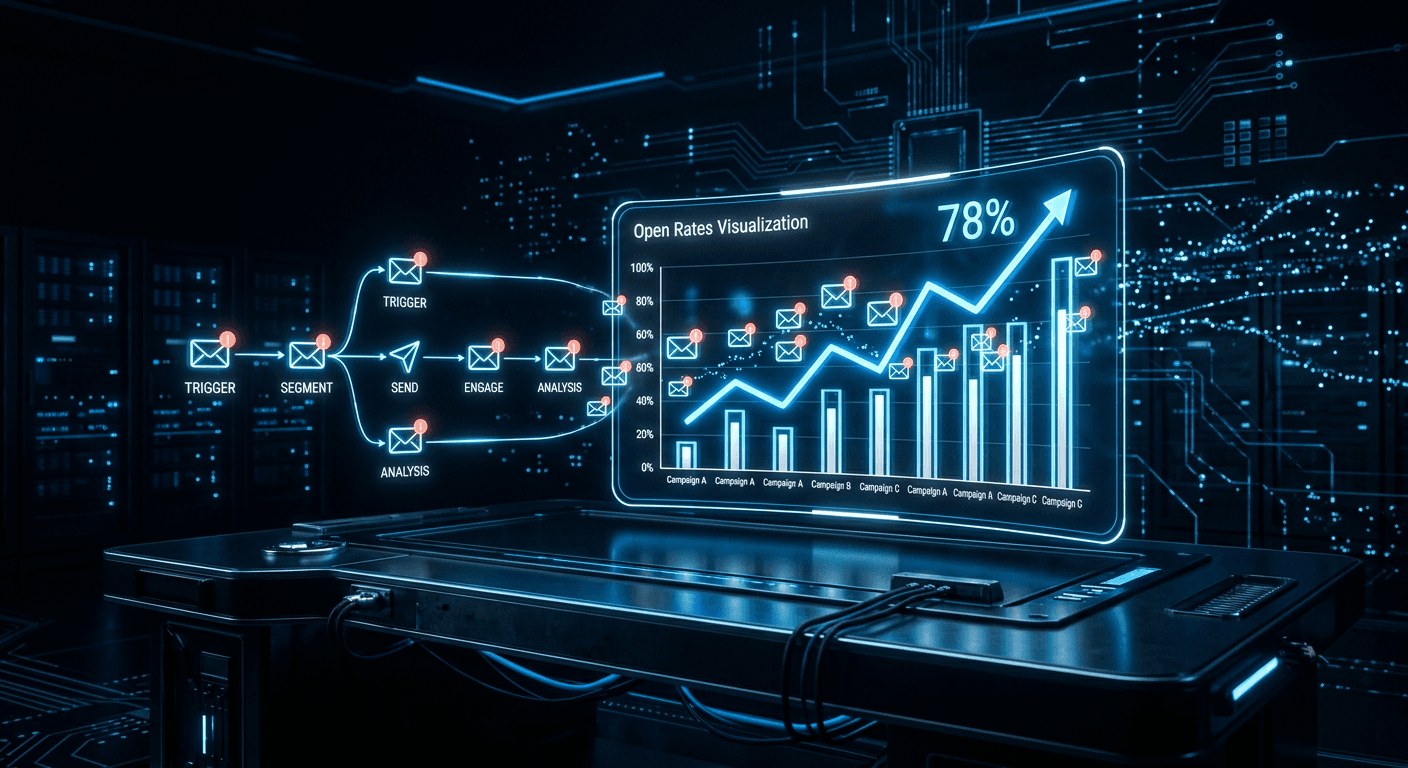
Most teams treat email as a series of one-off campaigns — write a newsletter, hit send, hope for the best, repeat next week. That approach leaves money on the table and burns hours every month. Email marketing automation flips the model: instead of sending the same message to everyone manually, you build sequences that respond to each subscriber automatically based on who they are and what they do.
This guide explains what email marketing automation actually is, the workflows that drive the most revenue, and how to build a reliable system using n8n alongside your existing email platform. No fluff, no theory — just what works.
What is email marketing automation?
Email marketing automation is software that sends targeted emails triggered by behavior, timing, or data rather than a person clicking send. A new subscriber receives a welcome series the moment they join. A customer who abandons their cart gets a reminder an hour later. A lead who goes quiet for 60 days gets a re-engagement offer.
The point is not to send more email. It is to send the right email at the moment it matters most, to the person most likely to act on it — at a scale no human could manage by hand.
Why it matters
Email remains one of the highest-return channels in marketing because you own the audience. Unlike social platforms, an email list cannot be throttled by an algorithm. Automation makes that list work harder by solving three problems at once:
- Timing — messages arrive when intent is highest, not whenever you happen to schedule a send.
- Relevance — each contact gets content matched to their stage and interests, not a generic blast.
- Consistency — every subscriber gets the same reliable nurture, so nobody falls through the cracks.
The core automation sequences
You do not need dozens of workflows. A handful of well-built sequences cover the vast majority of value.
Welcome sequences
The first 48 hours after someone subscribes are when engagement is highest. A welcome sequence of three to five emails introduces your brand, sets expectations, delivers the lead magnet you promised, and points new contacts toward a clear next step. This single sequence often outperforms every other email you send.
Drip campaigns
A drip campaign delivers a planned series of emails over days or weeks to educate, build trust, and move a lead toward a decision. Drips are ideal for onboarding, product education, and longer sales cycles where one email is never enough.
Behavioral triggers
The most powerful emails respond to what people actually do. Behavioral triggers fire based on real actions — a page visited, a link clicked, a cart abandoned, a demo booked. Because these messages match live intent, they consistently earn the highest open and conversion rates.
Re-engagement campaigns
Every list accumulates inactive contacts. A re-engagement campaign reaches out to subscribers who have gone quiet with a compelling reason to return — or politely confirms whether they still want to hear from you. Cleaning out the truly dead contacts also protects your deliverability.
Segmentation and personalization
Sending everyone the same email is the fastest way to get ignored. Segmentation divides your list into meaningful groups so each one receives relevant content. Common segments include:
- Lifecycle stage — new lead, active customer, churned.
- Behavior — what they have clicked, opened, or purchased.
- Attributes — industry, role, location, or plan tier.
Personalization then tailors the message inside each segment. This goes well beyond inserting a first name. The strongest personalization uses real data — recommending products based on past purchases, referencing the specific page someone viewed, or adjusting the offer to their lifecycle stage. The closer the email feels to a one-to-one note, the better it performs.
Deliverability basics
The best email in the world is worthless if it lands in spam. Deliverability is the foundation everything else sits on, and it comes down to two things: authentication and reputation.
- Authenticate your domain. Set up SPF, DKIM, and DMARC records so inbox providers trust that your mail is genuinely from you.
- Send only to people who opted in. Purchased lists destroy reputation fast and often violate privacy law.
- Keep your list clean. Remove hard bounces immediately and prune chronically inactive contacts.
- Watch engagement. High opens and clicks signal a healthy sender; spam complaints and ignored mail train providers to filter you.
Treat deliverability as ongoing maintenance, not a one-time setup.
Metrics that matter and how to act on them
Track a small set of numbers and, more importantly, know what to do when they move.
- Open rate — a proxy for subject lines and sender reputation. If it drops, test new subject lines and check your authentication setup.
- Click-through rate — measures whether your content and calls to action resonate. Weak clicks mean your offer or copy needs rework.
- Conversion rate — the only metric that ties to revenue. Optimize the landing page and offer, not just the email.
- Unsubscribe and complaint rates — early warnings of irrelevance or over-sending. Rising numbers mean better segmentation or less frequency.
Pick one metric to improve at a time, run a single test, and let the data guide the next move.
How to build it with n8n
You do not need to abandon your current tools to automate well. The practical setup keeps your email service provider for sending and adds n8n as the automation brain that connects everything.
- Map the journey. Write down each trigger and the email it should send — sign-up, purchase, inactivity, and so on.
- Connect your sources. Wire your forms, website events, and CRM into n8n so it can listen for the triggers you defined.
- Build the logic. Use n8n to apply conditions, wait steps, and branching — for example, pause a sequence the moment someone replies or converts.
- Hand off to your ESP. Let n8n call your email platform's API to send the right message and update the contact's segment.
- Add error handling. Build alerts so a broken integration never silently stops your sequences.
This pattern gives you full control over segmentation and timing while keeping the deliverability strengths of a dedicated ESP. If you also nurture leads through other channels, pairing email with a broader content marketing automation workflow keeps your messaging consistent everywhere.
Common mistakes to avoid
- Automating before you segment. Sending automated blasts to one giant list is just spam on a timer.
- Set and forget. Sequences need review; offers, copy, and timing all decay over time.
- Ignoring deliverability. Skipping SPF, DKIM, and DMARC quietly tanks every campaign that follows.
- Over-mailing. More frequency rarely means more revenue — it usually means more unsubscribes.
Getting started
The fastest path to results is to build one sequence well rather than ten poorly. Start with a welcome series — it touches every new subscriber and pays off immediately — then layer in behavioral triggers as you learn what your audience responds to. Email automation also pairs naturally with the broader workflows in our sales automation guide, so the leads you nurture flow straight into your pipeline.
If you want a system built, connected, and maintained for you — authenticated, segmented, and tuned to your audience — that is exactly what we do. Tell us about your goals and we will design the right email automation strategy for your business.
Frequently Asked Questions
Email marketing automation is the use of software to send the right email to the right person at the right moment — triggered by behavior, time, or data instead of manual sending. Welcome sequences, abandoned-cart reminders, and re-engagement campaigns all run on their own once the rules are set up, so your list stays warm without daily effort.
An email blast is a single message sent to your whole list at once. Automation sends tailored messages to individuals based on who they are and what they do — a new subscriber gets a welcome series, an inactive contact gets a win-back offer. Blasts are one-to-many; automation is one-to-one at scale.
No. Most teams keep their existing email service provider — like Mailchimp, Brevo, or SendGrid — and add an automation layer on top with a tool like n8n. That layer connects your forms, CRM, and ESP so behavioral triggers and segmentation work across all of them without switching platforms.
Deliverability comes down to authentication and reputation. Set up SPF, DKIM, and DMARC records, send only to people who opted in, keep your list clean by removing hard bounces, and watch your engagement rates. Low open rates and high complaints train inbox providers to filter you out, so quality always beats volume.
Related Articles

Content Marketing Automation: A Practical Guide for 2026
How content marketing automation works — calendars, repurposing, multi-channel distribution, lead magnets, nurturing, and connecting it all with n8n.

AI Marketing Automation: A Practical Guide for Teams
How AI changes marketing and sales automation — lead scoring, personalization, and AI agents in n8n — explained with practical use cases, not hype.
Lead Generation Strategies & Automation: A Practical Guide
A practical guide to modern lead generation — capturing, qualifying, enriching, and nurturing leads, and how n8n automation ties the whole system together.

Social Media Automation: A Practical Guide for Teams
What social media automation can and cannot do — scheduling, content recycling, social listening, lead capture, and building reliable workflows with n8n.